Measure from the same corners
Start at a visible corner and trace the room in the same direction as your numbered sketch. Identify the exact faces where the tape or laser reading begins and ends. If an obstruction prevents a diagonal, use accessible points and record their offsets explicitly. Enter a diagonal between actual corner vertices only after you have resolved those offsets.
Four boundary lengths can fit different quadrilaterals. A measured diagonal constrains two triangles. For a room with more corners, select further diagonals that split the outline into triangles without crossing a wall or a recess. The sketch tells you which side of each diagonal the relevant vertices occupy.
Work a four-sided example
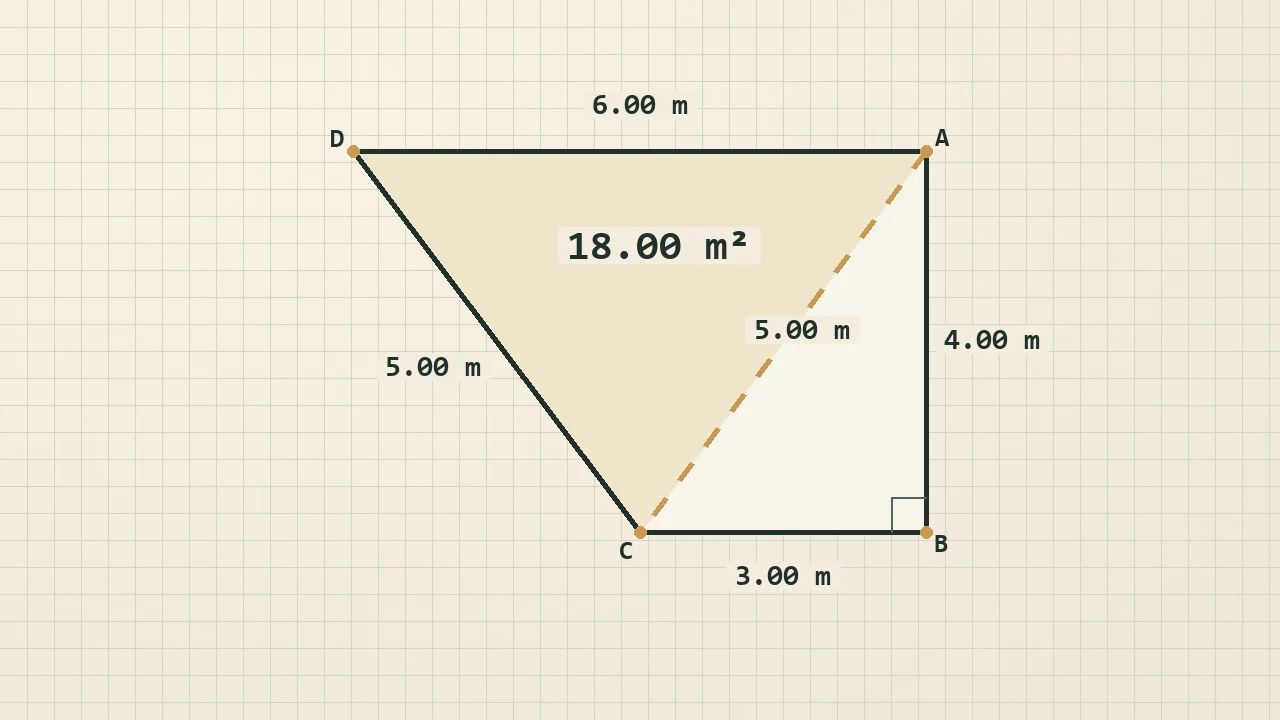
Use the practice outline shown here. Walk A–B–C–D with boundary lengths of 4, 3, 5 and 6 m. Measure diagonal A–C as 5 m. In Obmero, the edge values are 400, 300, 500 and 600 cm and the diagonal is 500 cm.
With A at (6, 0), B at (6, 4), C at (3, 4) and D at (0, 0) in metres, the measured diagonal gives triangles ABC and ACD. Their areas are 6 m² and 12 m², so this convex room has a plan area of 18 m². A CAD result can be compared to this numerical check.
- Select or draw the four-sided room and complete the edges in order.
- Enter the diagonal for vertices 1 and 3, corresponding to A and C.
- Generate the plan and compare the resulting edge lengths and area with the example before exporting.
Investigate a contour that will not close
Check the corner order first. A diagonal from vertex 1 to vertex 3 and one from vertex 2 to vertex 4 control different triangles. For each triangle, the longest side must be shorter than the sum of the other two. In the sample, a diagonal of 7 m would be impossible for the triangle with 4 m and 3 m sides because it would flatten the triangle.
An L-shaped room with confirmed right angles can also be checked along the horizontal and vertical directions. Opposing runs should balance around the boundary. Draw the recess in its true positions and verify that no connecting edge or wall return was missed when the perimeter was measured.
Watch the walkthrough
How a diagonal fixes the shape of an angled roomQuestions and answers
Why do four wall lengths leave the room shape ambiguous?
A four-sided outline can change its angles while keeping the same edge lengths. A measured diagonal constrains those angles by forming two triangles.
Should I measure both diagonals?
One diagonal constrains a four-sided room with known sides. A second measured diagonal gives an independent check and can reveal a wrong vertex or misread number.
Sources
Related guides
- Building measurement checklist for an existing floor planRecord wall lengths, opening positions, recesses and independent checks before you turn a measured survey into an existing floor plan.
- Export a measured floor plan to DXF, DWG, PDF or JPEGChoose the right file for CAD editing, review or printing. Check millimetres in model space and verify the A4 sheet at the selected scale.